
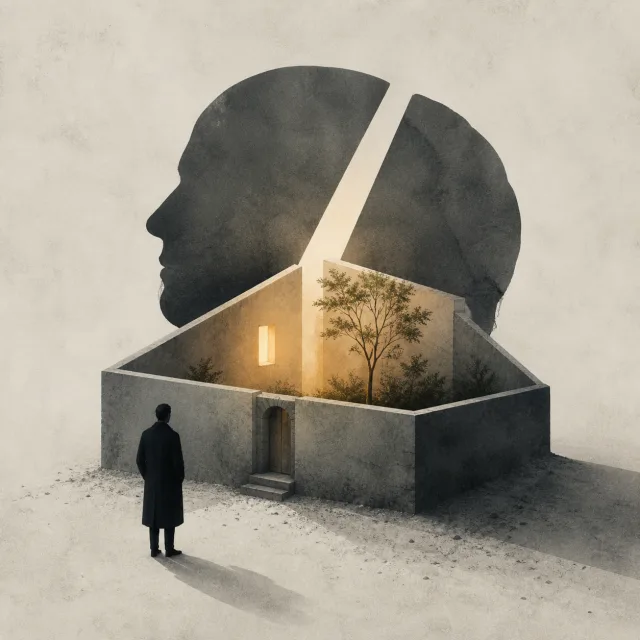
It was the heat from the concrete that I noticed first, a heat that, when the sun had finally dropped behind the western ridge of the valley, did not dissipate as it ought to have done in the natural course of things, but rose instead in thick, shimmering updrafts from the exhaust vents of the sprawling structures that lay half-buried in the scrub, leaking their immense thermal waste into the air. I had been walking since morning, or what I took to be morning, guided only by the raw angle of the light, lacking entirely the interior chime, the gentle, anticipated algorithmic pressure that used to orient my waking hours, a pressure that would tell me not only the precise hour but the optimal disposition of my body within it, so that now, abandoned to my own unmediated neurology, there was only the dull ache in my knees and the uninterpreted dust beneath my boots.
They had not taken my eyes, nor my hands, nor the memory of the morning I was asked to leave. My daughter had packed a small canvas bag for me, folding the shirts with a meticulous, unnecessary precision, smoothing the collars flat against the fabric while the adjudicators waited in the hall. We did not discuss the algorithms, nor did we discuss the illicit queries that had triggered the alarms. "The nights are getting colder out there," she had said, her voice entirely even, her hands hovering briefly over the canvas before she zipped it shut. "You should keep the wool sweater near the top." It was an ordinary sentence, polite and practical, carrying the entire unspoken weight of a permanent severance, a finality that, in cutting the invisible tether that bound me to the network, rendered not only my family but the physical world profoundly mute.
A stone was just a stone, carrying no overlay, no geologic history, no predicted trajectory, just as the scrub, devastated by years of drought and the slow creep of the desert, was simply an expanse of grey-green agony that I was forced to confront without the comforting buffer of statistical analysis. I found myself pausing before a stunted acacia, waiting, with a humiliating and persistent hope, for the botanical classification to bloom in my peripheral vision, waiting for the silent hum of the network to contextualize the tree, to tell me if it was dying or thriving, but the air remained empty. The mind frays when it is left entirely to its own devices, attempting to cast its net out into the world and pulling back nothing but the rough, unprincipled fabric of nature.
To walk past the datacenters—those sleeping giants humming beneath the earth—was to walk past the very architecture of my exile. I could feel their heat through the soles of my shoes, and I knew, with the sudden, impoverished abstraction of an unaugmented brain, that within those concrete walls petabytes of data were circulating, that the enclave from which I had been cast out was sustaining itself on that continuous flow, and that somewhere in that digital darkness were the records of my life, the voices of my friends, the algorithms that had once completed my thoughts before I had even formed them. It was a quiet, absolute devastation that required no words, primarily because there was no longer anyone, or anything, listening.
I sat down eventually, though the decision to stop was not so much a decision as it was a failure of momentum, a sudden, sheer inability to compel my legs forward without the subtle, systemic dopamine rewards that the network had once administered for reaching optimal cardiovascular thresholds. I sat on a slab of fractured concrete near one of the exhaust vents, wrapping the wool sweater my daughter had packed around my shoulders, feeling the immense, humming vibration of the servers beneath the earth as a substitute for the cognitive vibration that had once filled my mind. The sun was gone entirely now, and the desert scrub around me fell into a profound, terrifying darkness, a darkness unmitigated by the overlay of infrared topography or night-vision enhancements that I had come to rely upon as naturally as one relies upon the lungs to draw breath.
Without the algorithms to curate the night, the stars appeared overhead not as a catalogued expanse of navigational reference points and orbital debris, but as a chaotic, indifferent scattering of light. It was in looking up at them, feeling the cold begin to seep through the wool despite the proximity of the thermal vent, that I remembered a conversation with Elias, a colleague who had worked in the predictive modeling division. We had been standing in the enclave's upper concourse, drinking a synthetic tea that tasted vaguely of jasmine, watching the artificial rain cycle wash the glass dome. "The mind is a sieve," Elias had said, holding his cup with both hands, his gaze fixed on the water streaming down the reinforced panes, "and the network is the water. If you turn off the tap, you don't discover the true shape of the sieve. You just discover that it is empty." He had smiled then, an ordinary, polite smile, the kind of smile one offers when making an observation that is entirely theoretical, completely unaware that within a year, the theoretical would become the physical reality of my banishment.
There was a cruelty in how intact the memory was, uncorrupted by the severance, playing back with a fidelity that made the current silence all the more cavernous. I closed my eyes, attempting to summon the calming, recursive breath-loops the system used to initiate whenever my cortisol levels spiked, but there was no initiation, no gentle correction of my physiology, only the raw, biological panic of a primate left alone in the dark. I pulled my knees to my chest, listening to the vast, mechanical respiration of the datacenters, the sleeping giants that held the minds of my family, the mind of Elias, the entire sum of human endeavor from which I had been erased, and I realized, with a clarity that required no artificial augmentation, that the most devastating part of exile was not the physical hardship of the scrub, but the agonizing slowness with which the unassisted brain apprehends its own ruin.


